The Fortress of Kahar
The Front Gate
Synopsis
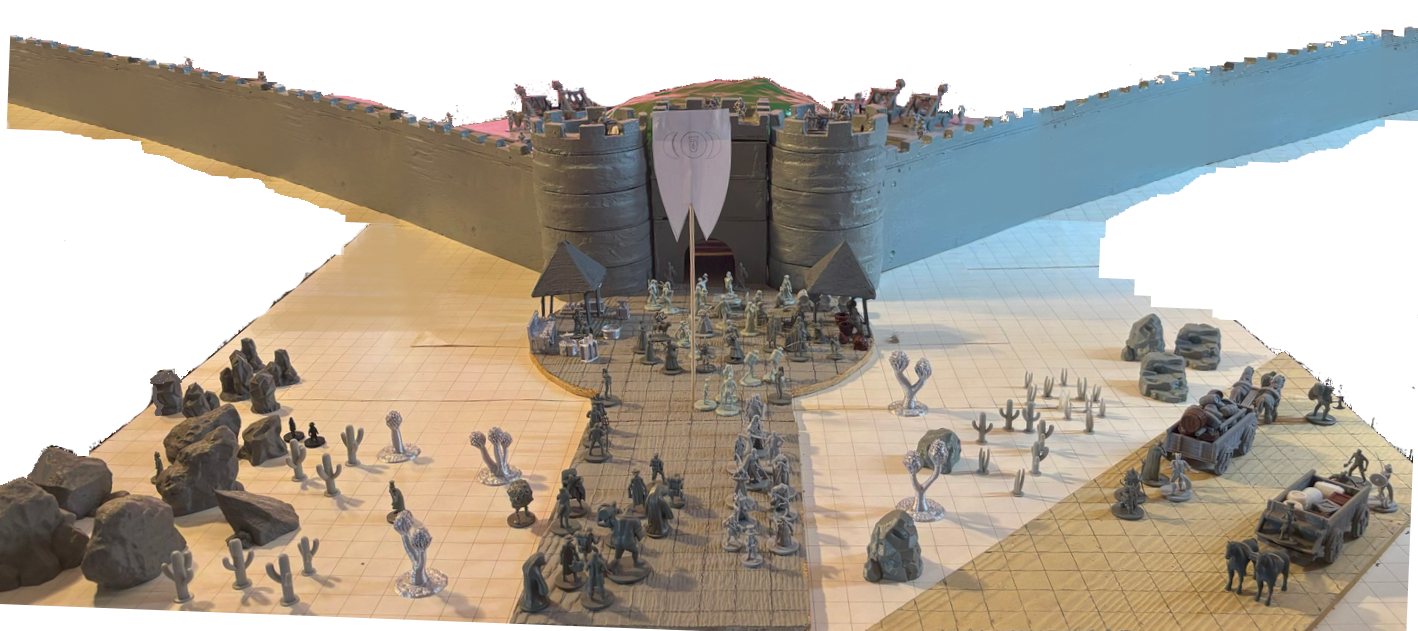
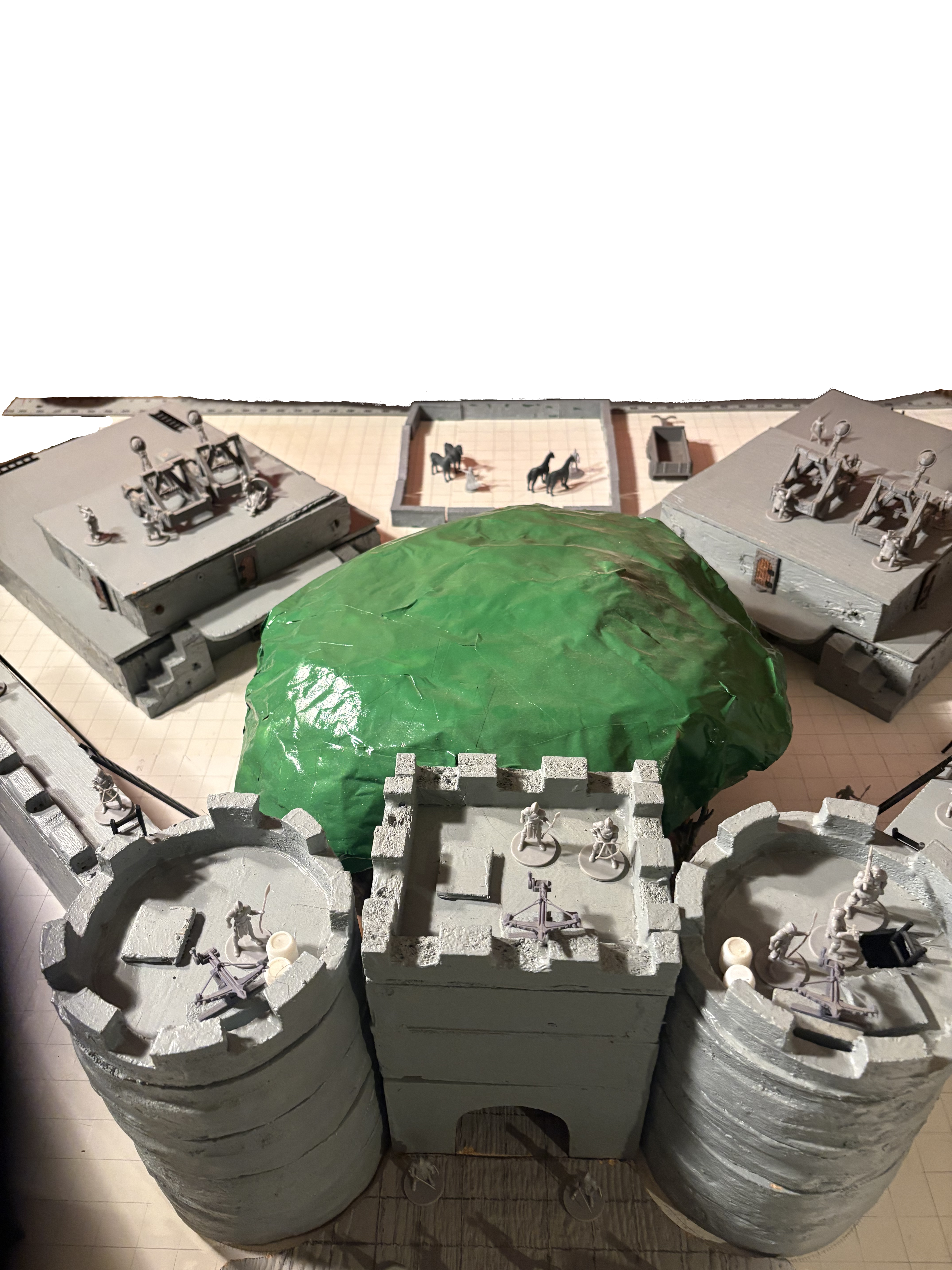
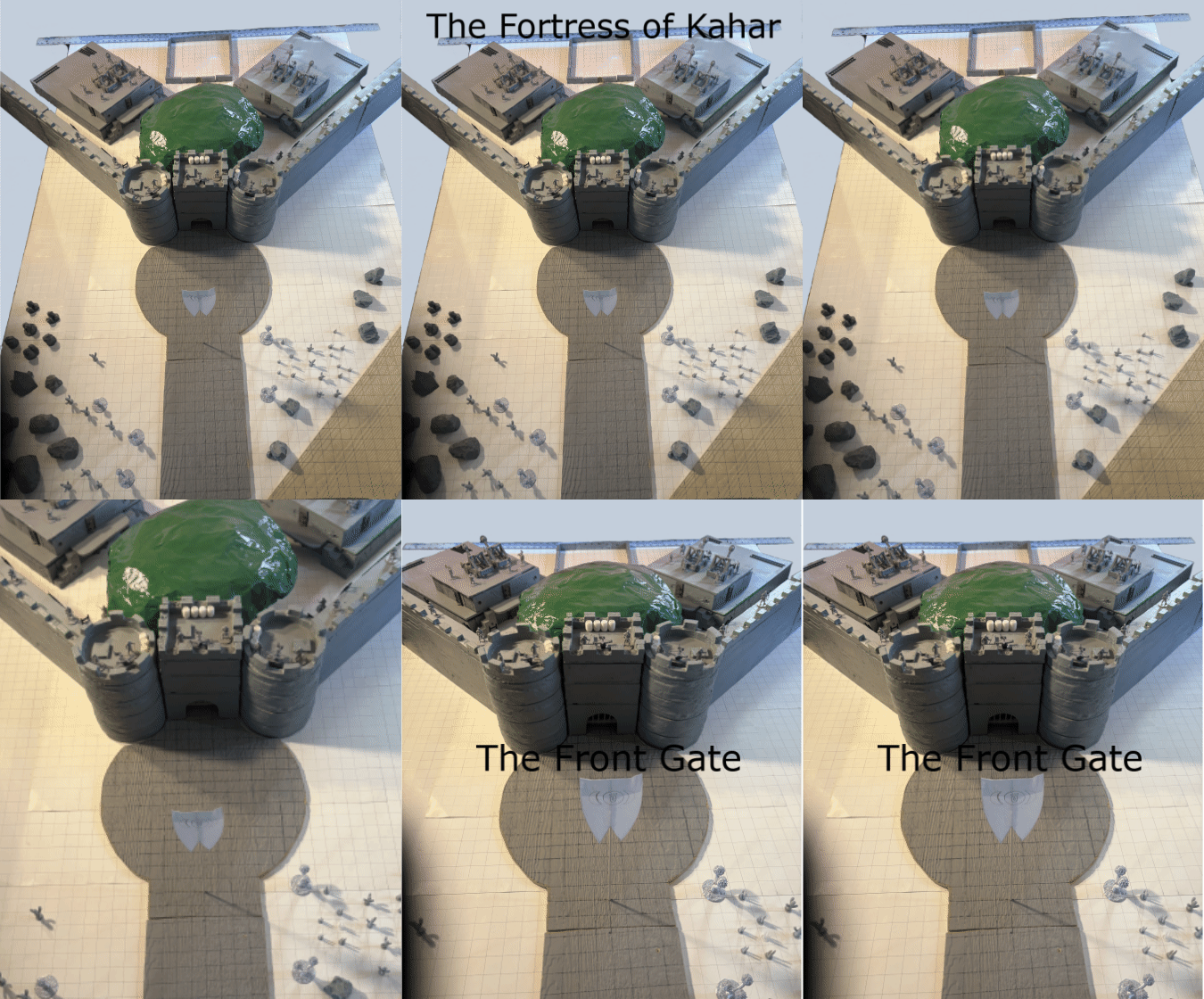
The Front Gate is at the southern tip of the fortress. It is composed of Tower 1 on the west, the Front Gatehouse in the center, and Tower 9 on the east. The Front Gatehouse has two portcullises that bar entry to the fortress, the towers are windowless and doorless. The protective walls, set at forty-five degree angles to the towers, are 30 foot high and 12 foot thick and extend for miles north, enclosing the fortress villages and hamlets.
The towers, the Front Gatehouse, and the protective walls are made of adobe brick, and protected by warding spells. The great stone paved plaza in front of the Front Gate provides space not only for the mustering of troops, but also for community gatherings and celebrations. Merchants, shopkeepers, and traders from distant lands arrive here every day, bringing exotic goods and stories of far off places.
Pilgrims of the many gods, scholars studying the old world, and curious adventurers all pass through the Front Gate on their way to Tatu hamlet, Domain of Many Temples. The Front Gate is the busiest and most active part of the fortress, and the soldiers stationed here are among the most experienced and battle hardened in the entire fortress.
Each tower houses 16 soldiers on four levels, and there are two 85 foot long x 65 foot wide buildings just behind each tower that house both commissioned and non-commissioned officers.
Defenses and Armaments
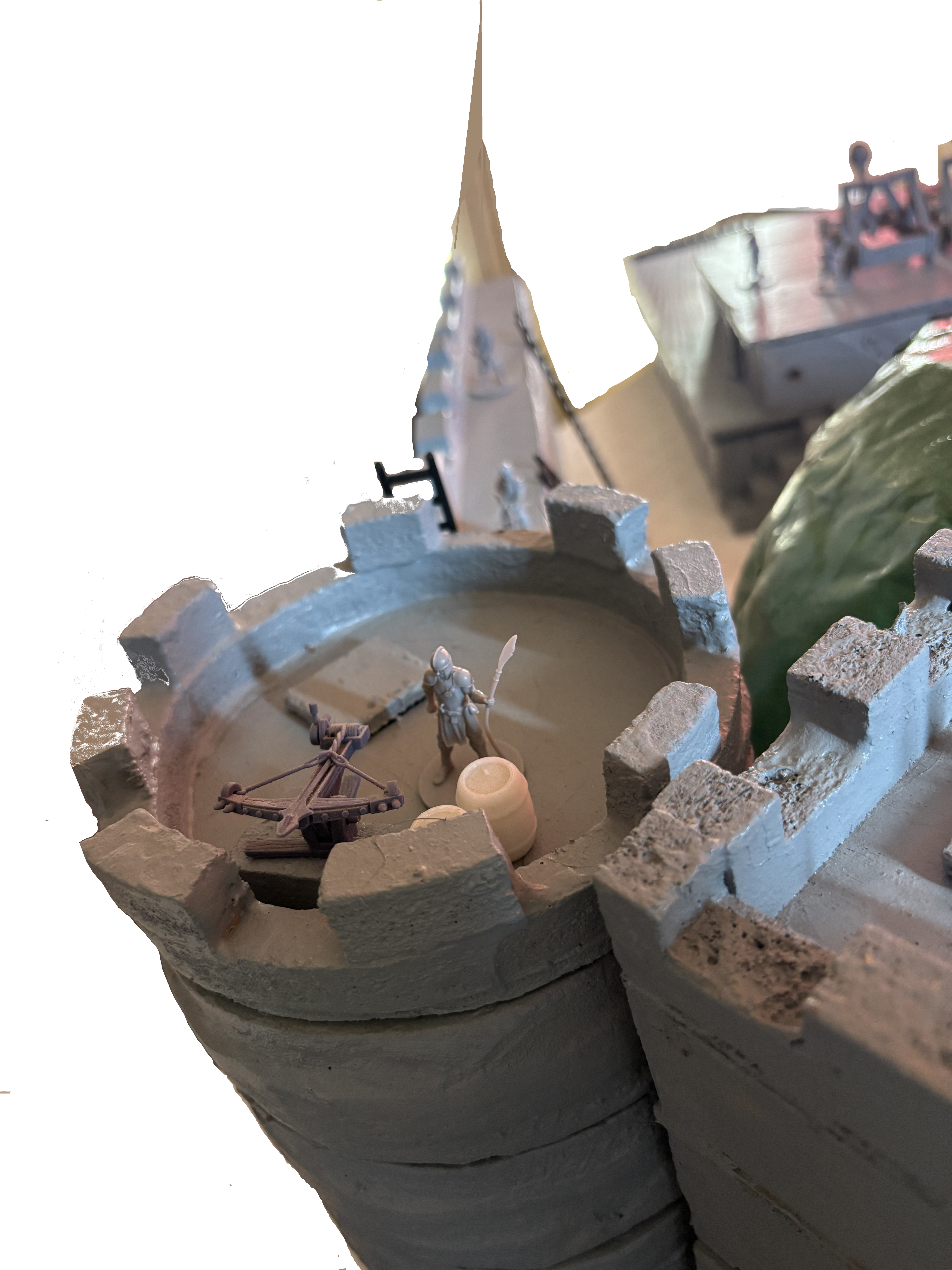
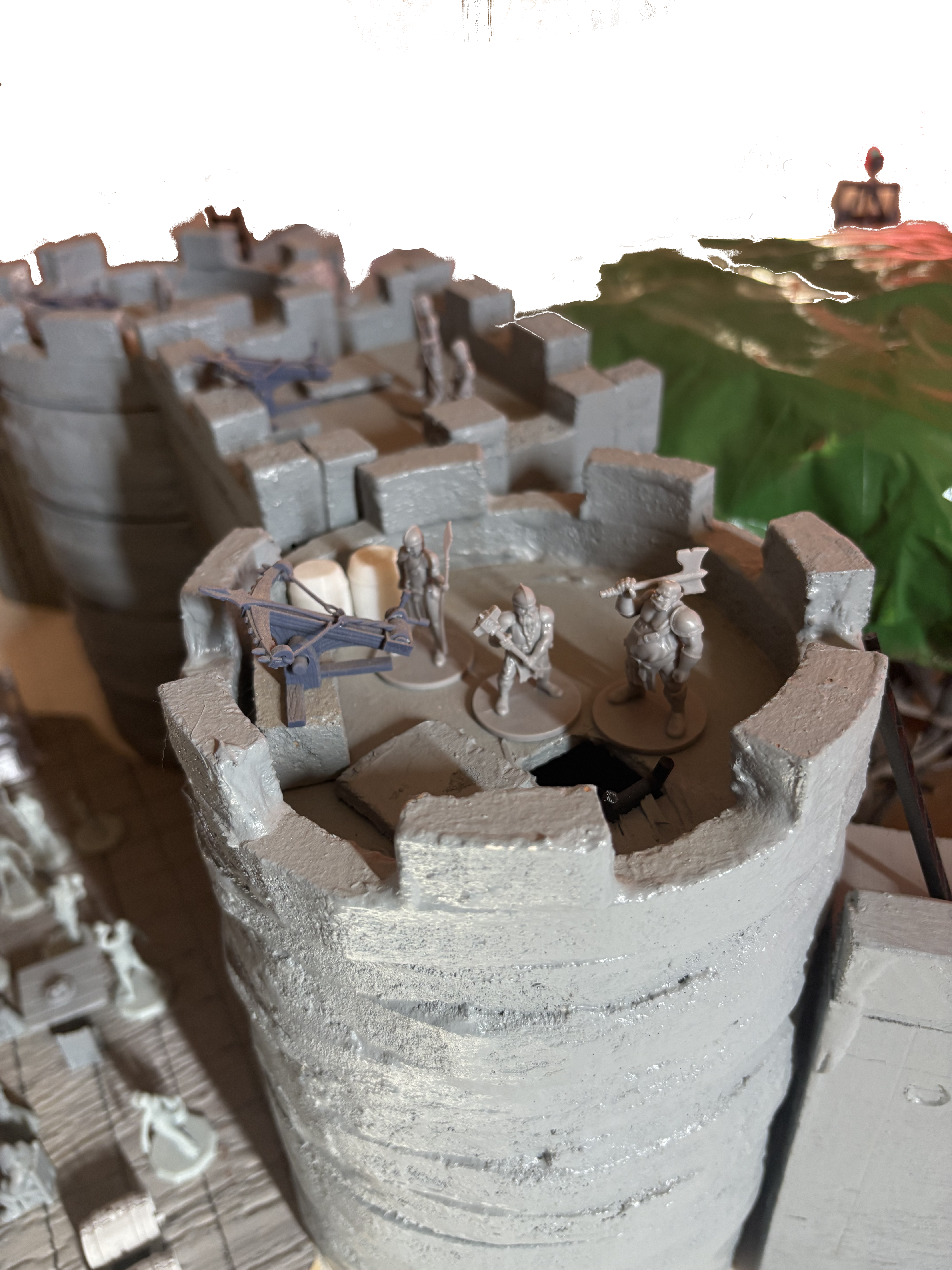
The Front Gate is heavily fortified with ballistae mounted on the towers and gatehouse, capable of launching large bolts at approaching enemies. Barrels of bolts line the roof top, providing plenty of ammunition. Archers are stationed on the battlements, ready to rain arrows and bolts, rocks and stones, logs and beams, and boiling liquids down upon any attackers.
The Front Gate House
The gatehouse itself is equipped with murder holes, defenders will raise the outer portcullis, allowing enemies to enter, but, on dropping the portcullis again, the enemies get trapped inside the Front Gate House and inbetween the twin portcullises, becoming easy targets for the defenders. The second floor has four beds for the four Chaplains that not only man the portcullises, but also provide care, counseling, and reinforce core values for the 32 soldiers split up and housed 16 a piece inside each tower.
The Officer Quarters
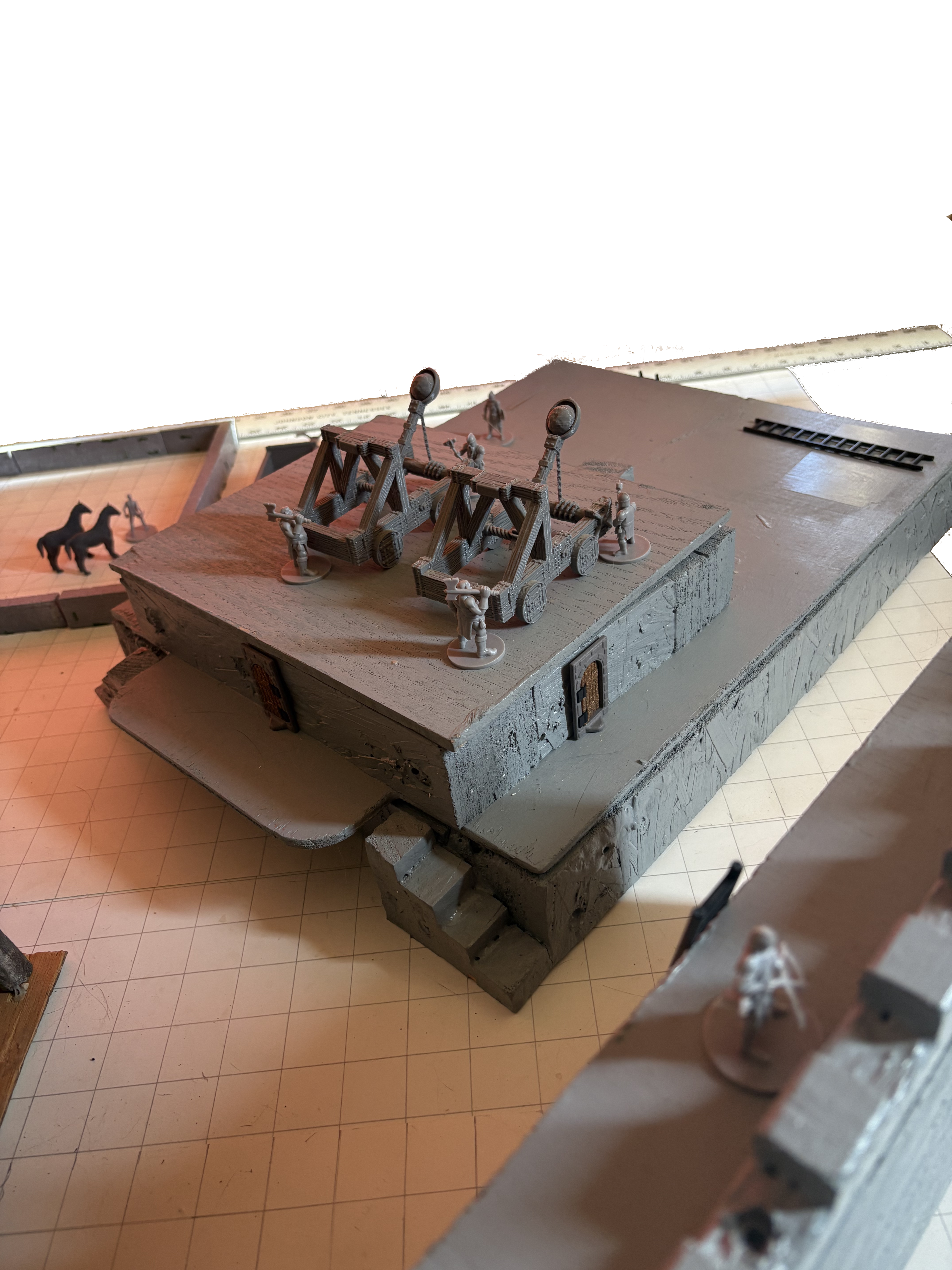
Behind every tower, the soldiers have constructed 10 foot thick walled adobe buildings, 65 foot wide and 85 foot long, with another thick walled room on top, 40 foot long and 50 foot wide. On the top of the second roof, 20 foot above the desert floor, they set 2 mangonels, with large piles of stones. These weapons can reach enemies up to 800 feet away.
Here at the Front Gate, there are 2 such buildings, set at odd angles to each other but parallel with the angled walls. The 4 mangonels here are backed up by and and additional 4 mangonels each, for a total of 16 mangonels protecting the fortress entrance.
Captain Chen, Lieutenant Reese, Inquisitor Su, and Master Sergeant Harper are stationed in the west building's lower level. Above them are 2 Sergeants, Dusak and Reed, and 2 Corporals, Walton and Pierce. On the east side lower level are the 4 bishops, and in the smaller building above are the other 2 Sergeants, Webster and Wheeler, and the other 2 Corporals, West and Weaver. The four levels of each tower house 4 soldiers each, while the lowest level of the Front Gate House houses the 4 Chaplains.
No doors nor windows, only ladders
Access to the tops of the walls and towers is gained by 30 foot tall ladders, and these ladders are everywhere, 10 foot, 12 foot, 20 foot, there is no end to the number of ladders belonging to the defenders. Roof hatches provide access to the lower levels of all the towers. The exceptions are the Officer Quarters, these will have doors, but no windows.
Chain of Command
The Front Gate is commanded by Captain Chen, with Lieutenant Reese as his second-in-command. Tower 1 is under Master Sergeant Harper, while Tower 9 is usually overseen by Lt. Reese, herself, but falls back on either Sergeant Carla Webster or Sergeant Guy Wheeler when Lt. Reese is absent.
The Front Gatehouse is garrisoned by the four chaplains; Abbott, Fuzdin, Axton, and Manning, who train regularly on raising and lowering the portcullises. The chaplains are solely responsible for who enters the fortress through the portcullis gates, but they also will be available for small gatherings like study groups, or prayer and devotional meetings.
The bishops will not only ensure the soldiers attend religious services and provide counseling as needed, but are also heavily trained in the use of both mangonels and trebuchets, and will pass down that knowledge to the squads. During battle, both chaplains and bishops have magical abilities that can heal and restore wounded soldiers, and their presence during such times is invaluable. The sergeants and corporals are responsible for training the soldiers in the art of warfare and defense of the fortress.
The Front Gate is a huge structure consisting of two 30' diameter towers that reach 45' high, flanking a Front Gate House that spans 30' wide, is 25' deep, and also reaches up to a 45' battlement roof. Every six days, the garrison assigns a few soldiers to paint the entire structure with a mixture of lime and water, helping to preserve it from the harsh desert environment.
The Copse of Trees
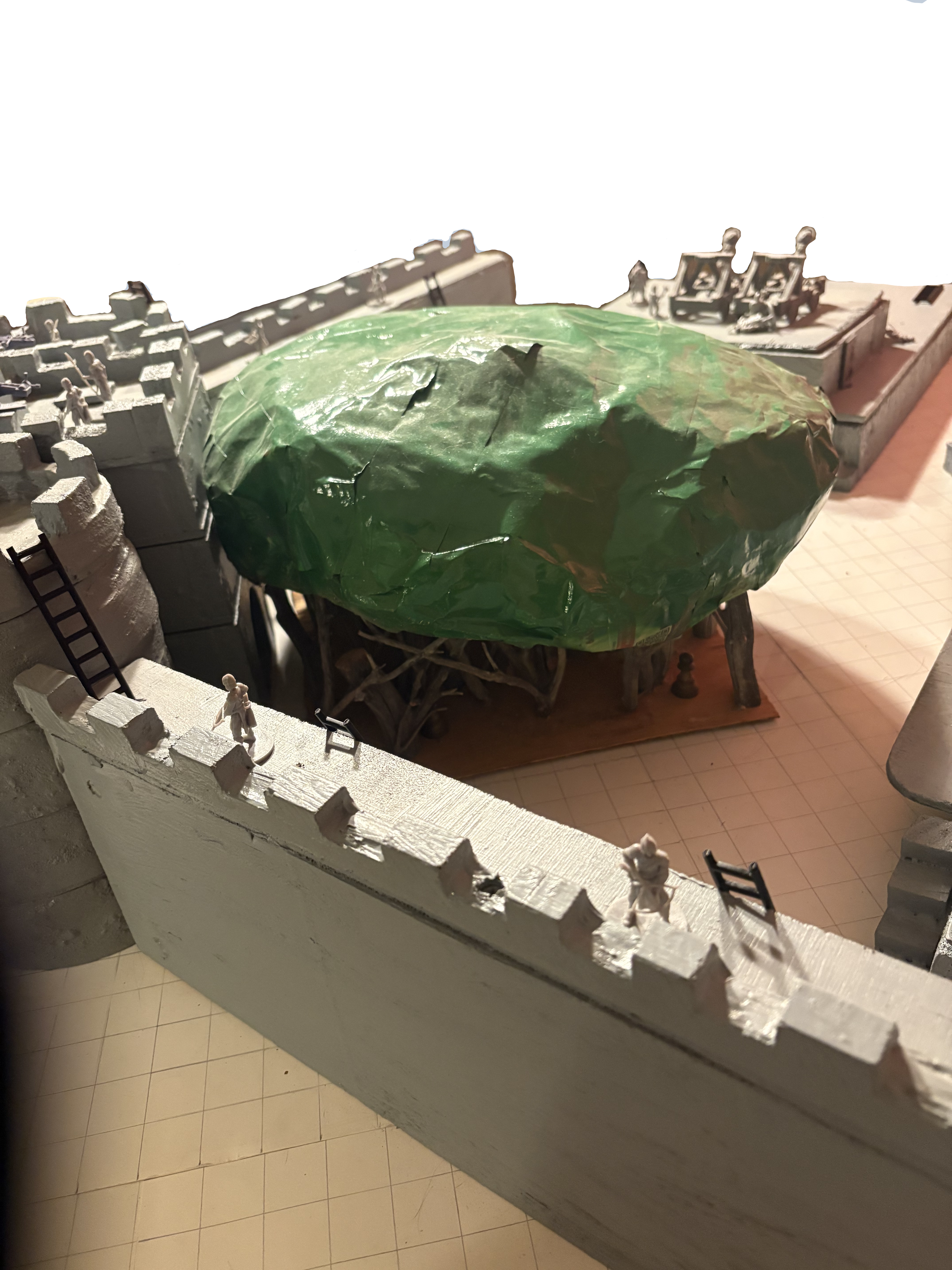
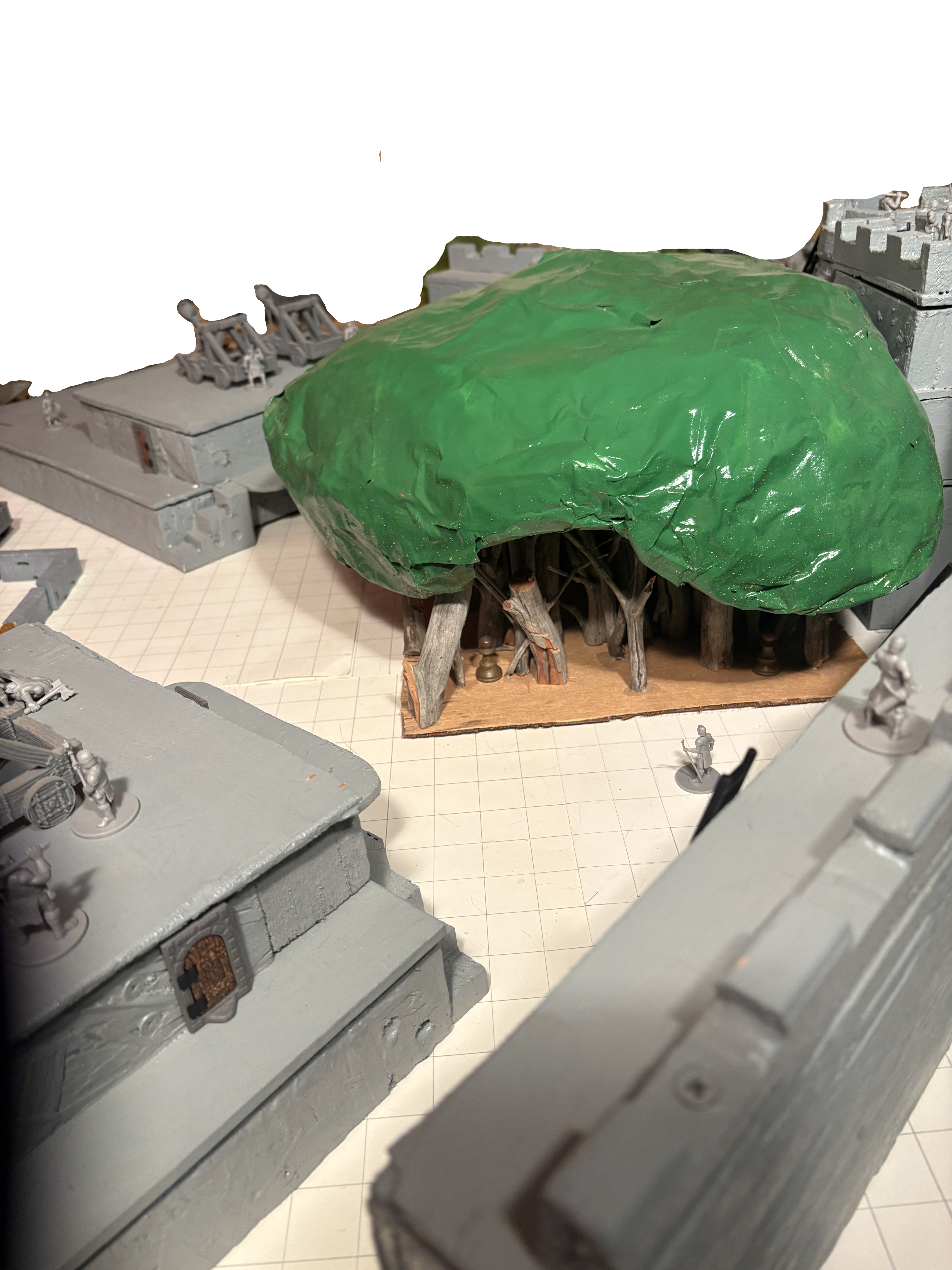
Adjacent to the Front Gate House, touching its northern wall, lies a small copse of trees, taking up an area of 60' x 60'. These trees are pruned and trimmed regularly so that a large tunnel passes under them. This tunnel exactly lines up with the portcullis gate, allowing those who enter the Front Gate House to walk directly into the copse of trees.
The floor of the tunnel is a raked, dirt path and the walls are lined with thick roots and vines from the trees above, so much so, that it is impossible to see through the copse walls. The ceiling of the tunnel is formed by the interwoven branches and leaves of the trees, so thick, that only dappled sunlight filters through.
Hidden within the copse are 3 foot tall, 1 1/2 foot wide stone pillars, each weighing a couple of hundred pounds. These pillars are enchanted with powerful conjuration spells, and when placed in a rectangular formation they become powerful teleportation devices. Anyone who enters the Front Gate House, passes through the twin portcullises and the great chamber in between, and then walks through the tunnel under the copse of trees, will find themselves exiting Apperton's Arch and entering into the north part of the fortress, completely bypassing the Royal Triangle. This teleportation cannot be felt and only the most astute observers will notice the slight shift in the air as they pass through the copse. Only a select few know the secret of how to bypass the "Pillars of Janae" as they are called, and enter the Royal Triangle. The soldiers tending the copse know about the four ancient monoliths and the two dryads that dwell there that they are ordered never to disturb.
The Classroom
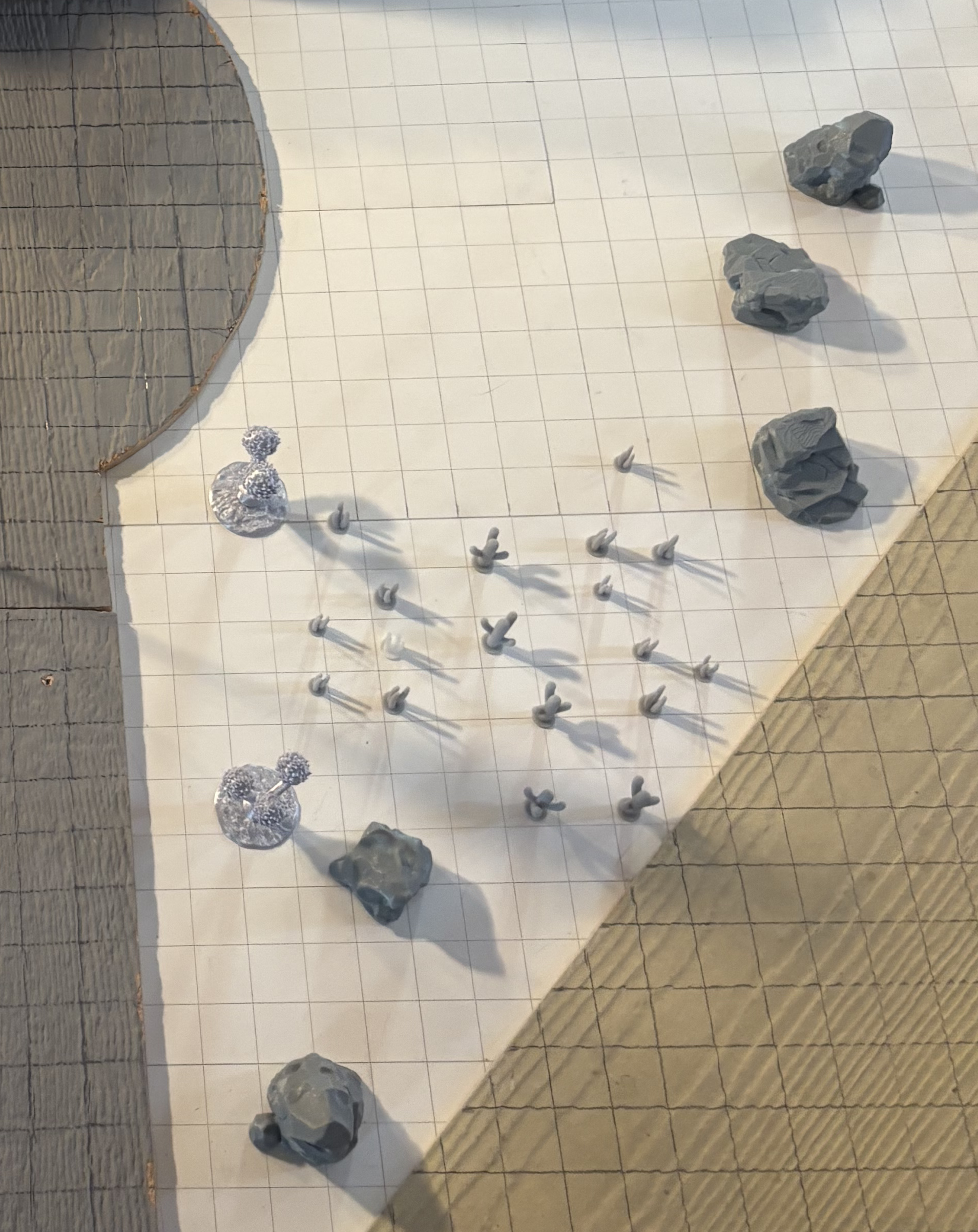
Sixty five feet south of Tower 9 and ten feet east of Desert Front Road stands the first of the twenty foot Joshua trees. These large desert trees, with their stout trunks and distinctive branching, bear spiky, sculptural, dagger-like blue-green leaves clustered at the ends of each limb, along with seasonal clusters of creamy white flowers. Thirty feet farther south stands the second Joshua tree, rooted beside a giant boulder. Between these two trees lies the entrance to the Classroom.
Six silver torch cacti fill the first four hundred and fifty square feet of the area. Beyond them is a five foot open space, followed by five tall saguaro cacti covering the next three hundred square feet. The following four hundred and fifty square feet contain six more silver torch cacti, and ten feet beyond that stands the first of the three great boulders that define the Classroom's southern boundary.
In the mornings, young teachers gather here to guide children through simple but essential social and emotional skills; sharing, empathy, self-regulation, and foundational practical habits such as manners, communication, and responsibility. After lunch, older teachers instruct teenagers and young adults in the practical arts of independent living: nutrition, cooking, budgeting, textiles, and childcare, all aimed at strengthening homes and community well-being.
By late afternoon, the Classroom transforms. The children disperse, and the many magicians of the region arrive to practice their disciplines. Training here is not merely a matter of casting spells into open air; it is a structured contest of distance, timing, and terrain. Some magicians take their positions atop Tower 9, using its height to test long range accuracy and defensive wards. Others remain on the ground among the great boulders, using the stone formations as cover while attempting to strike the tower or disrupt the casters above.
These sessions were deliberately asymmetrical. After a round of long range exchanges, the roles would reverse: those on the tower would descend its outer wall, quietly, carefully, and often with the aid of minor spells, to flank the ground based magicians. The ground casters, in turn, learned to anticipate these maneuvers, shifting between boulders, cactus clusters, and open lanes to avoid being outmaneuvered. In this way, the Classroom served as both a proving ground and a living laboratory, where magicians refined their craft through friendly rivalry, tactical creativity, and the ever changing dance between elevation and concealment.
Just south of the Classroom ran the twenty foot wide paved road known as Rear Gate Cutoff Road, the primary connector between Desert Front Road and the Rear Gate. It also passed through 2 villages beyond. Throughout the day it carried a steady flow of carts, horses, traders, and messengers. The sounds of hooves, wagon wheels, and shouted greetings drifted into the Classroom, becoming a familiar backdrop to both lessons and magical practice. Children often paused their morning exercises to watch brightly painted carts roll past, while in the afternoons the magicians learned to cast and counter spells amid the unpredictable noise and movement of passing traffic. The proximity of Rear Gate Cutoff Road ensured that the Classroom was never isolated; it remained a public, visible space woven into the daily life of the community.
The Playground
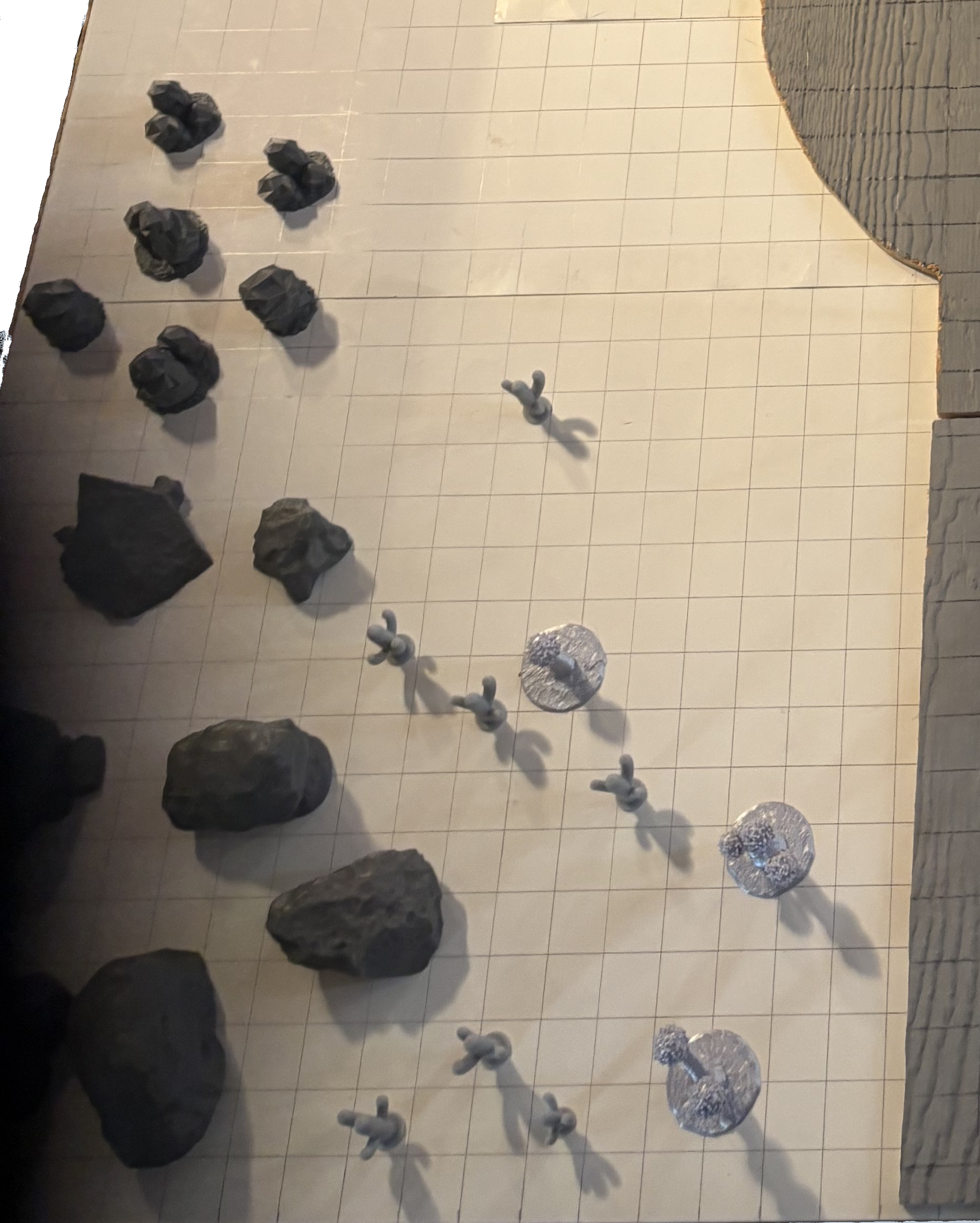
The Playground was a large rock park located one hundred and thirty feet southwest of the Front Gate. Seven great boulders dominated the area, each one weathered smooth by generations of climbing hands and desert winds. Ten feet north of the boulders stood six pillars of giant gems, set apart in their own quiet clearing. Just east of the boulders grew seven tall saguaro cacti and three broad limbed Joshua trees, marking the natural boundary of the play area and offering pockets of shade during the hottest hours of the day.
Children came here after chores and after class, filling the Playground with shouts, laughter, and friendly competition. Challenges were made to see who could climb the highest boulder, who could leap the furthest gap, or who could scramble through the narrow crevices fastest. The gem pillars served as meeting points, hiding spots, and imagined fortresses in countless games. For many of the young near the Front Gate, the Playground was the heart of their afternoons — a place of freedom, daring, and shared stories.
The Playground did not begin as a planned park. During the early construction of the Front Gate and its surrounding defenses, workers cleared large quantities of stone from the site. The seven great boulders that now define the area were the largest pieces left behind — too heavy to move farther, but harmless enough to remain where they settled. Over time, the children of the nearby hamlets began climbing on them, turning the abandoned stones into an informal play area.
The desert flora that borders the Playground was added later. The seven saguaro cacti and three Joshua trees were planted intentionally by the soldiers to honor Zaslo, the god of flora, whose followers believed that even utilitarian spaces should be marked with living tribute. Their presence gave the Playground shade, structure, and a sense of quiet guardianship.
The six pillars of giant gems were the final addition. They were set in place after the Third Dark Crusade as memorials to the towers that had been torn down by the enemy during the conflict. Each gem pillar represents one of the fallen towers, their faceted surfaces meant to catch the sun in the same way the towers once caught the morning light. Though simple in origin, these pillars became a familiar landmark for generations of children who played among them.
Notable Events
Barely two and a half years after the 3rd Dark Crusade, when the last scaffolds were struck from the rebuilt towers of Kahar, word reached the Front Gate that the outer villages and desert hamlets were starving. Trade had not returned, the irrigation ditches lay broken, and too many hands had been lost to war. At great cost to themselves, the nobles of Kahar levied their own stores and purchased grain from distant caravans, hauling it through the Gate in long, dust-choked lines. Their intervention saved many who would otherwise have perished, and the Front Gate became, for a season, the lifeline of the desert.
In the 54th year since the founding of Kahar, a distant goblin settlement, founded by the scattered survivors of those broken armies, sent an unexpected plea to Kahar. Their wells, once fed by deep desert aquifers, had gone dry without warning, and the town stood on the edge of collapse. Though more than two hundred miles away and never fully friendly with the soldiers of Goldenshield, the goblins swallowed their pride and sought aid from the very fortress their ancestors had once besieged. The nobles of Kahar answered. They dispatched the Ecclesiastic Brigade, five clerics and a dozen paladin-barbarians, whose rites and labor restored the wells and saved the town from ruin. It was the first time in living memory that goblins had stood openly at the Front Gate not as foes, but as supplicants, and the moment marked a fragile, hard-won peace in the long shadow of the Crusades.
In the sixty-first year of Kahar, a desert thorpe south of the plateau was struck by a sudden and deadly sickness. Its only well had been fouled when a collapsed latrine pit seeped into the aquifer, and within days the villagers were collapsing from fever and thirst. The reeve and beadle, bound by the valley's secrecy and lacking healers of their own, could not contain the sickness. Quiet messengers were sent to Kahar, the only authority they dared trust. The nobles of Kahar did not hesitate. They dispatched the Ecclesiastic Brigade, whose clerics purified the well and whose paladin-barbarians dug new channels and enforced a strict quarantine until the sickness burned itself out. Dozens were saved, and the people of the thorpe remembered that when all others turned away, it was the Front Gate that answered.
In the seventieth year of Kahar, a hidden valley thorpe in the northern rice fields was struck by a sudden and deadly sickness. Its single well,fed by the ancient aqueduct that first transformed the canyon from barren rock into farmland, had been fouled when a collapsed waste pit seeped into the water table. Within days the farmers who supplied Kahar with grain and cattle were falling to fever and thirst. The caravan lords refused to intervene, claiming the valley was too remote and the risk too great. The nobles of Kahar acted without hesitation. They dispatched the Ecclesiastic Brigade, whose clerics purified the well and whose paladin-barbarians dug emergency channels and enforced a strict quarantine until the sickness burned itself out. The thorpe survived, and the people of the hidden valley remembered that when all others turned away, it was the Front Gate that answered.
The Front Gate has stood as the fortress threshold for as long as memory serves, but during the three year Bandit Wars it was never once threatened. The fighting raged far beyond the plateau, where scattered villages and caravan towns bore the brunt of the chaotic menagerie that rose from the wastes after the failed Dark Crusades; goblin remnants, splintered raider clans, desert lizardfolk, giant scorpions, night hag covens, scarecrow constructs, and even prowling packs of hell hounds. From the Front Gate, Lieutenant Chen and the soldiers of Tower 1, the Front Gate House, and Tower 9 rode out again and again, sometimes hundreds of miles, to shield innocents who had no walls of their own. Their relief missions and the desperate defensive stands they made beside those villagers became the legends carried across the desert. In the years since, the Front Gate has remained more than stone, it is the place where aid departs, where oaths are honored, and where the kingdom's promise to its people is renewed.
During the Bandit Wars of 113, when the King's Road was choked with raiders and the cries of the innocent echoed across the plateau, Lieutenant Chen went beyond his orders. Leading a daring night raid into the bandit encampments, he cut through the chaos not to claim spoils but to rescue villagers bound for slaughter. At his side was a young corporal, Cassandra Reese, whose quick thinking and steady bow turned the tide when Chen's squad was nearly overwhelmed. Together they broke the captives free and carried them back through the dark, earning not only commendations but the enduring trust of those they saved. It was in that crucible that Chen's legend began, and Reese's loyalty was forged, the bond that would one day place her as Lieutenant of Tower 9.